


January 20, 2026 – The global packaging industry is currently experiencing a shift from plastics and non-recyclable products to paper-based packaging. Food packaging trends are largely driven by sustainability factors, as well as functionality and consumer interest. Innovations span across a variety of formats and technological advances, with protection, moisture resistance, and shelf-life considerations at the forefront. Innova’s ” Trending in Paper-Based Packaging in F&B- Global” analyzes the major paper-packaging trends emerging in the global food and beverage market and how these trends can be leveraged in new product development to address consumers’ values and priorities.
Why Are Consumers Shifting to Paper Packaging?
In the global food and beverage market, food packaging trends are shifting toward recyclable paper packaging to act more responsibly. Consumers increasingly favor renewable, recyclable materials to reduce their environmental impact. 43% of consumers are choosing recyclable products to be more environmentally friendly. Plastic bans and global regulations are also pushing companies to adopt these packaging changes in order to comply with circular economy requirements or expectations.
The surge in delivery, takeaway, and on-the-go formats emphasizes the need for light yet durable packaging, while also meeting transportation and hygiene needs. Technology advances are also expanding the usability of paper, making it applicable to a wider range of contexts. Major brands like Driscoll’s, Nestle, and Mars are touting their shift to paper packaging, due to the public scrutiny that accompanies the use of plastic packaging.
How Gen Z & Millennials are Shaping Sustainable Packaging Demand
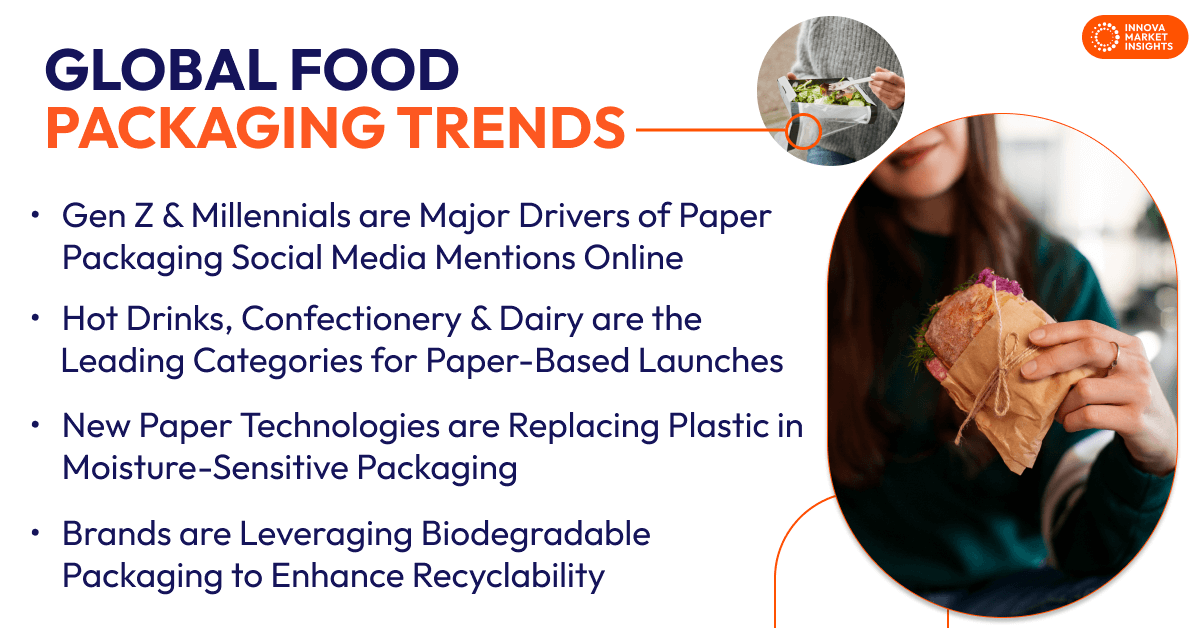
According to Innova’s social listening data, mentions of paper packaging trends in the global food and beverage industry are growing. Both brands and consumers are engaging with the topic, and growing interest can be seen in sustainability, convenience, and eco-friendly packaging. Gen Z and Millennials are also the major consumer segments driving the shift towards sustainable, paper packaging. In addition, male users are discussing aspects of technical efficiency and performance of paper-based materials, while posts from female users are focused on packaging materials and sustainability conversations.
Leading F&B Categories for Paper-Based Packaging
Hot drinks, confectionery, and dairy are the leading categories for paper-based food and beverage launches, experiencing positive CAGR growth since 2020. However, the demand for balancing sustainability with performance signals the need for more innovative packaging. Paper flat pouches, paper-wrapped chocolate squares, and paper cheese trays are a few examples of innovations brands are introducing to address consumer demand and responsibility. Paper caps are another avenue for eco-friendly and liquid-protective solutions in the paper-based packaging market.
Cutting-Edge Technology: Addressing Shelf-Life Concerns with Paper Barriers
Brands also have the opportunity to leverage new technologies in food packaging trends to address product protection and shelf-life concerns. For example, eco-friendly innovation can include paper-based containers for spices that reduce plastic use and promote lightweight designs. Shelf-life and protection concerns can also be addressed with heat-sealable paper solutions that replace plastic in dry food packaging. Furthermore, biodegradable materials are another global packaging trend, helping to close the loop on packaging circularity.
New paper technologies are also replacing plastic in moisture-sensitive packaging in the paper-based packaging market. For instance, Hansol Paper announced that it was able to apply “Protego,” a paper packaging material, to the matcha products of Green Mood, an organic matcha brand. With moisture and water resistance properties and lower carbon emissions, it has become an attractive option for brands seeking eco-friendly options.
Formats Replacing Conventional Plastics
In the Netherlands, PepsiCo has recently launched its fully recyclable cardboard “Snack Boxes” for the brand’s highly popular Lay’s and Doritos snacks. Previously, these snacks were packaged in plastic, non-recyclable formats, and this shift is another solution that cuts plastic waste but maintains functionality. These rigid carboard boxes also include “engaging on-pack messages” that encourage consumers to reuse the packaging and extend the lifespan of the box beyond initial use.
What’s Next for Food Paper Packaging Trends
Looking to the future of food packaging trends in the paper-based packaging market, brands have significant scope to develop materials with improved barrier properties, such as those that can handle moisture, grease, oxygen, and heat. Brands can also aim to integrate recycling systems, optimize local sourcing, and establish localized assembly of paper-based formats. Curbside recyclable laminates, for example, are one method that can be utilized to promote closed-loop systems.
This article is based on Innova’s Trending in Paper-Based Packaging in F&B- Global report. This report is available to purchase or with an Innova Reports subscription. Reach out to learn more.