


April 24, 2026 – One challenge in the cheese alternatives global market is that most consumers who eat non-dairy cheese also eat cheese that is dairy. This means that strict veganism doesn’t lead to supporting the non-dairy cheese category. Also, a percentage of consumers globally who eat dairy cheese also eat cheese alternatives. Seeing the crossover between cheese eaters and eaters of cheese alternatives means that dairy cheese and non-dairy cheese alternatives could copy each other. Another bit of good news is that cheese hybrids that are dairy and plant-based could attract consumers. Non-dairy cheese has to be sure to maintain its taste, texture, and value in order to hold onto its share.
Cheese Eaters Want Taste, Functionality, and Value
Shoppers globally who eat dairy cheese or dairy-free cheese alternatives want cheeses that taste good, are functional, versatile, and deliver value, reflecting consumer preferences for cheese. Companies that produce plant-based cheese alternatives must match cheese on many levels – flavor, meltability, and cheese-like properties. The challenge is that consumers are price-sensitive, and they may decide not to buy a more expensive cheese alternative if it doesn’t meet their expectations. It is imperative that dairy alternatives deliver a true cheese experience.
Boost Occasions for Dairy Cheese and Cheese Alternatives
Both dairy alternative cheese and traditional cheese have opportunities with younger and older consumers. Brands can create additional occasions for dairy cheese or non-dairy cheese among current users to avoid having to attract new users. Dairy cheeses can consider additional marketing claims pertaining to the environment, animal welfare, and vegetarian. These may not require a product reformulation but instead highlight features that already are inherent to dairy cheese and dairy alternative cheeses.
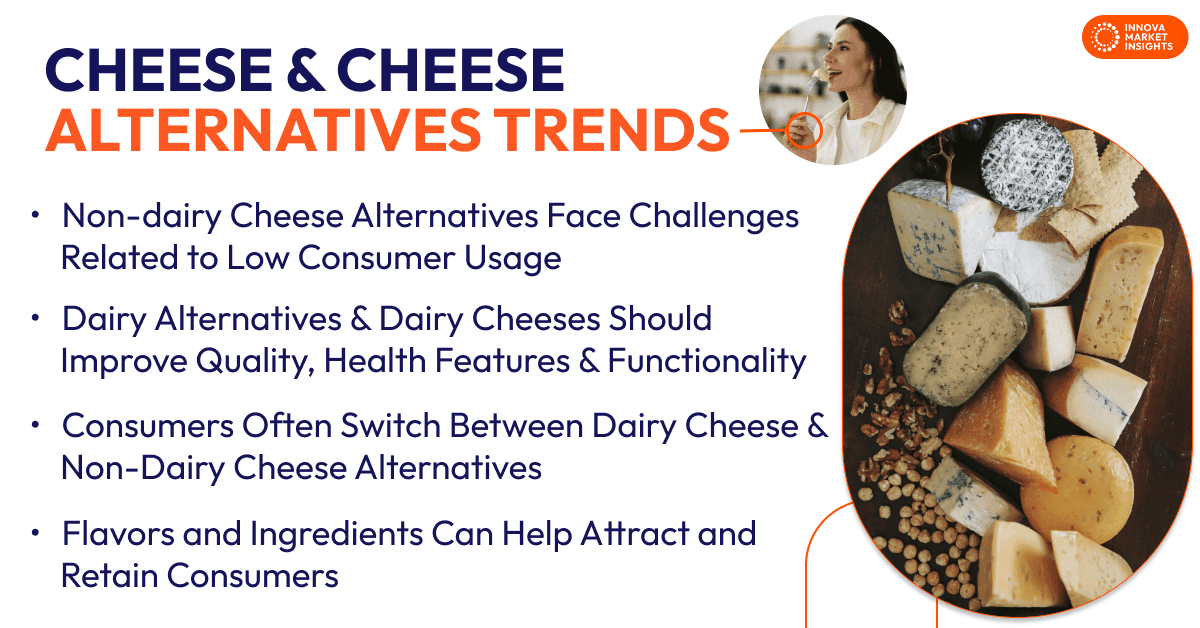
A goal for plant-based cheese should be to encourage current users to eat more cheese alternatives. Very low percentages of consumers eat non-dairy cheese, and they tend to eat it less often. A lot of consumers globally eat cheese alternatives less than one time per month. Very few cheese alternatives consumers around the world eat non-dairy cheese more than twice per week. It may not be realistic for cheese alternatives to try to match the frequent cheese consumption. What brands in the cheese market can do is establish value by improving quality, health profile, functionality, and ethical features.
Non-dairy Cheese Faces Challenges
Non-dairy cheese alternatives face a difficult future. Dairy cheese eaters and non-dairy cheese eaters cross over into each other’s categories. This is particularly true for consumers of dairy-free cheese. Traditional cheese and cheese alternatives can copy from each other to gain competitive advantages. Plant-based cheese in particular needs to show that it can stand up dairy cheese and match its features.
Cheese Alternatives Can Compete on Ethics and Health
Non-dairy cheese alternatives need to establish themselves based on ethics and on health. However, dairy cheese can claim to be vegetarian and promote ethical treatment of animals, like dairy alternatives support treatment of animals because they don’t require animal products. These features in dairy cheese might attract consumers of non-dairy cheese because a majority of these consumers also eat dairy cheese.
Non-Dairy Cheese and Dairy Cheese Can Feature Flavors and Ingredients
Non-dairy cheese and dairy cheese could gain advantages by emphasizing ingredients and flavors. It is common for cheese to talk about using high-quality milk. Cheese alternatives may emphasize the quality of their ingredients like nuts, oils, and grains. Regardless, dairy alternatives cheese and dairy cheese can emphasize the connection between their ingredients and associated health claims. Flavors are underutilized in dairy alternative cheese and dairy cheese. Only one in five dairy cheeses and three in 10 non-dairy cheeses have flavors other than the widely used mozzarella and cheddar bases. Brands in the cheese market that add flavor can attract customer interest, including customers who want a lot of flavor but don’t want to work hard to get it.
What’s Next for Non-Dairy and Dairy Cheeses?
Non-dairy cheese alternatives can strive to boost cheese consumption and increase frequency of usage. Cheese alternative brands need to work to attract dairy cheese consumers. Expect companies to offer traditional cheese and non-dairy cheese alternatives, as well as to develop hybrid dairy/non-dairy products. Manufacturers of plan-based cheese must improve functionality and taste to help their products compete with dairy cheese. Increased usage can be encouraged by manufacturers by broadening the variety of their product line and offering ideas to consumers on how to use different types of cheese. Cheese can gain advantage by offering more choice and emphasizing ethical benefits. Both types of cheeses can be promoted through enhanced communications about ingredients, flavors, and benefits.
This article is based on Innova’s Cheese & Cheese Alternatives – Global report. This report is available to purchase or with an Innova Reports subscription. Reach out to find out more