



August 8, 2026 – When looking at sugar reduction trends, it’s important to define terms regarding sugar reduction. Low sugar means the product meets labeling guidelines for low sugar. Products that are labeled no added sugar could contain natural sources of sugars. Reduced sugar products have been reformulated to have less sugar. Sugar-free products have no sugar.
Governments and Brands Going Against Sugar
Sugar reduction is not just driven by consumers; it also is part of the global food and beverage marketplace. Governments are taking measures such as taxing products with sugar, banning advertising of sugary products, and issuing health warnings to try to bring down rates of diabetes and obesity. Consumers globally are increasingly conscious of their health and use sugar reduction as a key strategy. Brands are responding to consumer sentiment against sugar by innovating around low-sugar, no-sugar, and reduced sugar food and beverage products, including using alternatives to sugar.
Generational Differences in Sugar Reduction
Generations differ in their approach to sugar reduction. Older consumers are interested in reducing the amount of sugar they eat. Younger consumers, in contrast, tend to seek positive nutrition strategies that enhance nutrition and offer functional benefits rather than negative nutrition strategies. They also are more likely to be eating high protein rather than low sugar. Diets low in sugar are popular among Gen X and Boomer consumers. In these generations, diets low in fat also are more widely used than diets high in protein.
Consumers and Sugar Reduction
A solid majority of consumers globally say they watch how much sugar they eat and are working to reduce their sugar intake. Weight is a common motivator for this. Consumers want less sugar in cereals, ports nutrition sports nutrition products, beverages, and snacks. Nearly half of consumers globally say they are eating less sugar as a way to eat more healthily. A solid percentage say they are increasing fiber, so combining the two features could be attractive to consumers.
Innovation in Food and Beverage Products with a Sugar Claim
Food and beverage product launches with a low-sugar, no-sugar, or reduced-sugar claim have been rising over a recent five-year period, with accelerated growth in the most recent one-year period. Regions with the highest penetration of sugar-related claims are Australasia, North America, and Europe, but growth in new product launches is strongest in the Middle East, Africa, and Asia.
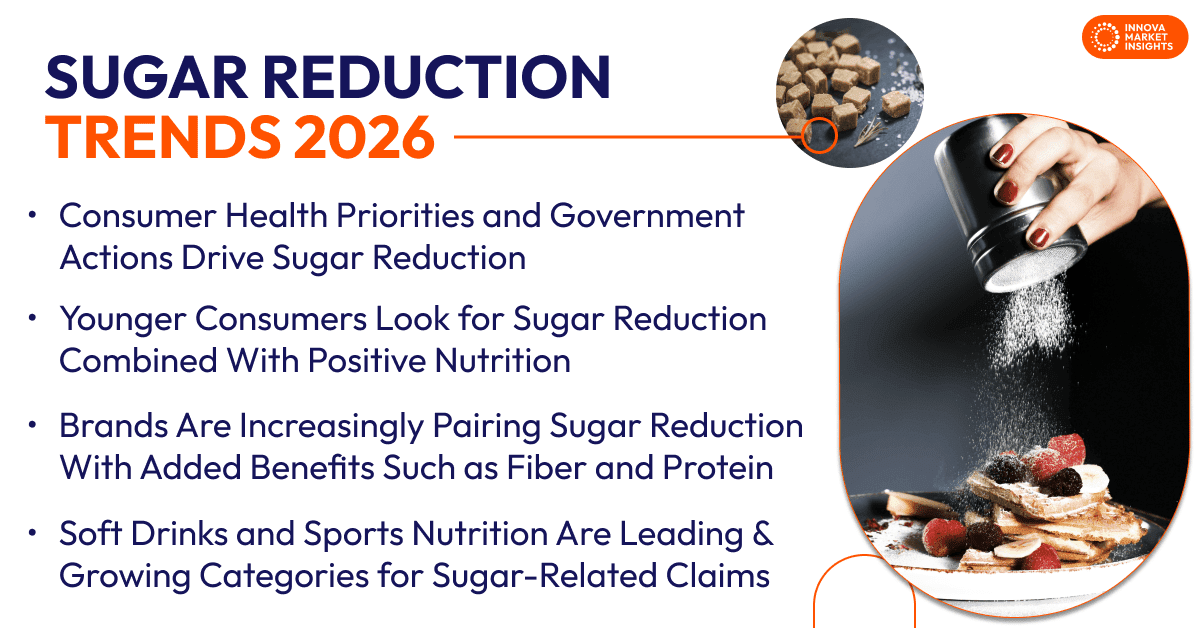
Top categories for reduced-sugar, low-sugar, and no-sugar claims are soft drinks and sports nutrition, and both categories are growing. Soft drinks is the top category for sugar reduction. Other growing categories are hot drinks, which show solid growth, snacks, and tabletop sweeteners. Growing categories with a reduced-sugar, low-sugar, or no-sugar claim that are popular with younger generations include energy drinks, waters with a plant-based claim, iced and hot coffee, and carbonated soft drinks.
Sugar reduction claims appear in products with health claims related to fiber, protein, hydration, energy, weight management, or gut health. About one in six launches with a sugar-related claim also have a fiber claim, with solid growth behind the trend. Growth is even stronger in sugar-reduced products with a digestion or gut health claim.
Prebiotic fiber ingredients have a sweet taste of up to 65% of the sweetness of sugar. This makes them suitable for sugar reduction. Specific prebiotic fibers with increasing use are oligosaccharides, chicory root, and inulin.
Sugar-reduced food and beverage products are appealing, especially in sports nutrition. A solid percentage of sports nutrition launches carry a sugar-related claim and growth is very strong. Consumers globally report eating more healthily by increasing their protein intake. That is pushing a growing number of brands to add protein and a protein claim to launches with a reduced-sugar, low-sugar, or no-sugar claim. Sports nutrition products with a sugar-related claim plus protein include protein powders, sports bars, RTD sports beverages, RTD protein drinks, and sports cookies and cereals.
Trends in Sweeteners in Sugar Reduction
Among sweeteners, allulose is growing the fastest in products with a reduced-sugar, low-sugar, or no-sugar claim. The top four sweeteners are sucralose, acesulfame-K, stevia, and maltitol.
What’s Next for Sugar-Related Claims?
Brands will be combining sugar reduction with positive features related to health in the form of adding nutrition-packed ingredients. This approach will appeal especially to younger consumers. Sweet fiber ingredients offer a lot of potential. It is easier to add them to a growing range of food and beverage products. They also can be used in place of some of the sweetener in high fiber, low sugar products. Suppliers will respond to government pressure to reduce sugar intake as a way to address high prevalence of diabetes and obesity.
Government actions can include sugar tax, bans on advertising, and mandatory warning labels, and companies are expected to formulate products to avoid these actions. Taste will remain important. Sugar replacement is not easy because sugar affects both taste and texture. Companies are formulating combinations of ingredients for sugar reduction that sweeten and replicate the texture of sugar. Sweetener science and sweetener technology are advancing the use of sweeteners to create products that are healthier and indulgent, to meet the high expectations of today’s consumers.
This article is based on Innova’s Sugar Reduction Trends – Global report. This report is available to purchase or with an Innova Reports subscription. Reach out to find out more