


April 30, 2026 – Europe owns cheese. The region accounts for 45% of global retail sales value, and European countries hold all 18 of the top positions in per-capita consumption rankings. Cheese is the number one dairy choice among European consumers, with 74% dairy food penetration across the region. Yet the market is mature. Sales growth is modest, and in a category where more than 2 in 3 cheese customers already eat it more than once a week, volume alone is not the answer. The question is not whether Europeans eat cheese. It is whether brands can make them eat differently. Innova’s Cheese in Europe report examines the consumer dynamics, generational divides, and product development directions shaping what comes next.
Who is Actually Buying Cheese Across Europe?
Cheese purchase increases with age, and the numbers make that plain. Boomers lead at 75%, followed by Generation X at 67%, Millennials at 55%, and Generation Z at just 47%. Older generations are the most important customers in the category today, reflecting current cheese trends. They value tradition, they buy regularly, and they are not going anywhere. The challenge is that younger consumers under-index for overall purchase, and when they do buy, they want something different. These consumers are looking for more variety, more novelty, and less of what their parents bought.
This is one tension impacting product development and innovation in the European cheese market. Brands are being asked to speak to a loyal but aging core while building genuine appeal for a younger generation that is present but not yet habitual. Both objectives must be pursued at the same time.
What is Driving Purchase Decisions in the European Cheese Market?
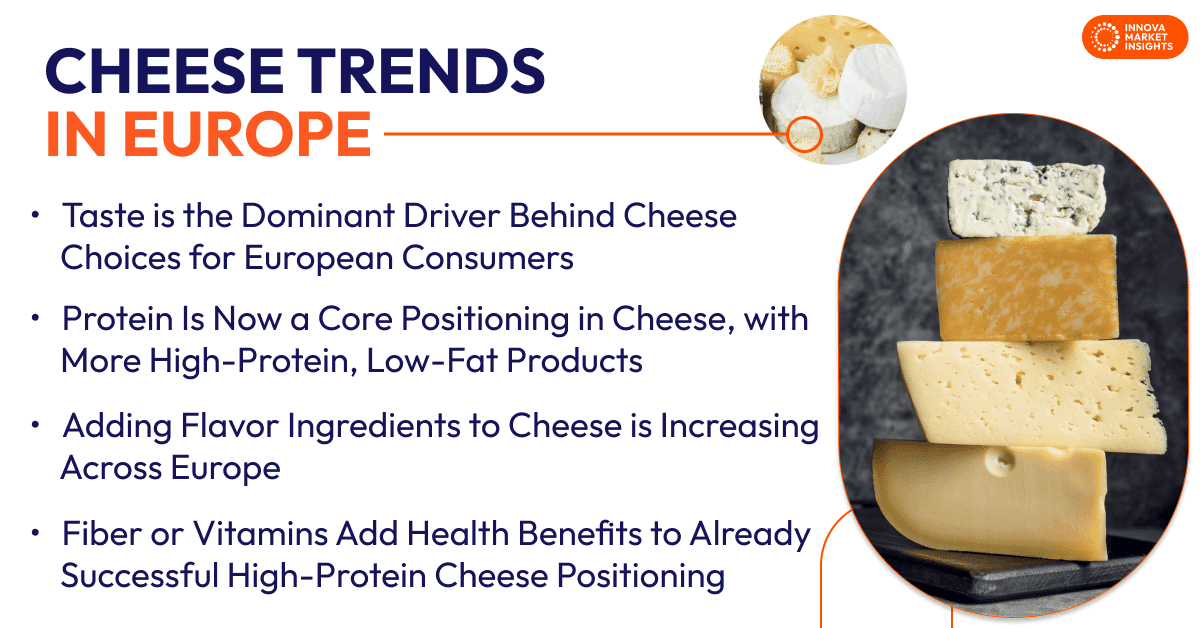
Taste is the dominant driver behind cheese choices for European consumers. Cheese trends reveal that flavor and eating pleasure are the first set of priorities, followed by health claims, sustainability credentials, and other characteristics. Nutritional benefits are valued, but they support rather than lead the decision. Brands that get this backwards, leading with function rather than taste, are working against the hierarchy of consumer preferences.
Quality is a significant consideration in both flavor and sourcing. Certified origin products and premium ingredients resonate well, particularly among older consumers who know what they want and pay attention to where it comes from. At the same time, social cheese occasions are on the rise, driving demand for hot-eating products and premium sharers. Consumers are buying cheese for the table as much as the fridge, and formats designed for groups, gatherings, and moments of indulgence are growing as a result.
How is the Protein Trend Reshaping Cheese NPD?
Protein has become a staple positioning in cheese, with more and more products placed on high-protein, low-fat platforms. This taps into a consumer appetite for foods that deliver functional benefits without sacrificing taste. One of the more notable effects of this shift is the re-emergence of cottage cheese as a popular choice. Long associated with diet culture and a somewhat dated image, it is attracting a broader, younger audience. Its naturally high protein content and versatile texture make it well-suited to the current health-forward agenda in new product development.
The protein trend also intersects with processed cheese, which is outperforming natural cheese formats within NPD. Processed cheese benefits from greater scope for genuine innovation. It can be engineered to hit specific nutritional targets, adapted to new textures, and built for usage occasions that traditional formats were never designed for. For brands with ambition in the functional space, processed cheese is currently the more productive canvas.
What Role is Convenience Playing in European Cheese Innovation?
Pre-sliced cheese is now a more popular choice for European customers than whole cheeses. That shift says something real about how consumers are engaging with the category: preparation time is a barrier, and formats that remove it win. Suppliers are pushing further. Baguette-shaped slices, baked cheese balls, and individual fondue formats are reaching shelves, combining ease of use with the kind of social and popular eating occasions that are growing in the cheese market.
Cheese trends highlight that for younger consumers especially, convenient formats are the entry point. Products that fit into lunch boxes, quick dinners, and casual entertaining are better placed to build habitual purchase among Millennials and Gen Z shoppers who currently under-index for cheese buying. Convenience is not a compromise on quality in this context. It is how the category gets a foothold in a new generation’s routine.
Which Flavor Directions are Gaining Ground in Cheese?
Adding flavor ingredients to cheese is increasing across Europe. Chili and mushroom stand out as on-trend choices, with chili aligning with the growing consumer appetite for heat and bold seasoning, and mushroom meeting the rise of umami and plant-forward eating. Both are familiar enough to be approachable and differentiated enough to justify a premium. Beyond these two, bold and unexpected flavor additions more broadly are becoming a tool for premiumization across the category.
For brands targeting younger shoppers, flavor is also a discovery mechanism. A distinctively flavored cheese gives a Gen Z consumer a reason to pick up a product they would otherwise walk past. Flavor innovation in cheese is not just about taste differentiation. It is about making the category part of a conversation younger consumers actually want to have.
What’s Next for European Cheese Trends?
The European cheese market is evolving, and brands that rely on the existing customer base without actively building new ones are accepting a slow decline. Five directions are worth watching closely. The first is protein expansion. The market is already responding to demand for high-protein, lower-fat platforms, and there is scope to go further. Adding fiber or vitamins to high-protein cheese products layers additional health credentials onto a positioning that is already working. The second is the GLP-1 effect. The use of GLP-1 weight loss drugs is increasingly allied to dietary changes and fat reduction, and cottage cheese sits well in that context. It is already on trend for its protein content, but its lower fat profile relative to most other cheese choices gives it a second reason to be the format that GLP-1 users reach for.
This article is based on Innova’s Cheese in Europe report. This report is available to purchase or with an Innova Reports subscription. Reach out to find out more