



July 17, 2026 – The Latin American chocolate confectionery market sits on a clear tension. Chocolate carries deep cultural roots and wide product penetration across the region, yet consumers still treat it as an occasional indulgence rather than an everyday habit. Closing that gap, and converting cultural pull into more frequent purchases, is the central growth challenge for manufacturers. Innova’s Chocolate Confectionery in Latin America report examines how brands are responding, shifting toward smaller formats, layered packaging claims, and occasion-based innovation to unlock more consistent growth.
Why Is Chocolate Innovation Shifting Toward Smaller Formats?
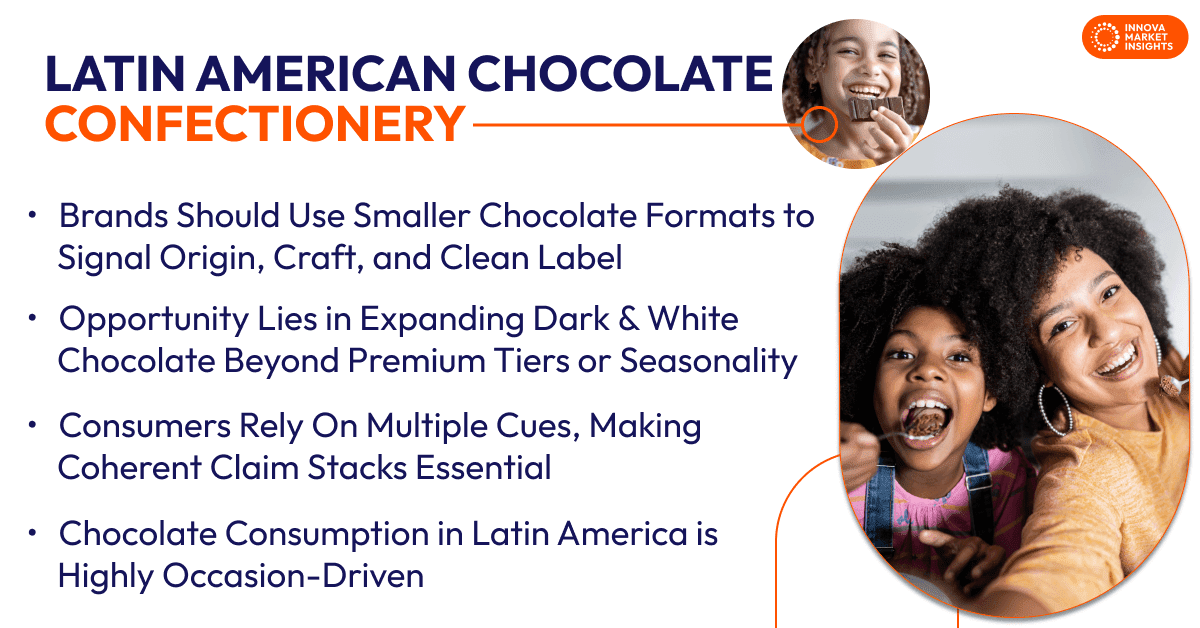
Brands are steering research and development budgets toward smaller formats and lower price points to lower the entry barrier for consumers. Innova’s launch data highlights that since 2021, launches of wrapped chocolate pieces have climbed, while chocolate bars have fallen. This indicates that new product development is moving toward smaller formats, as traditional bars and blocks stall. Smaller sizes also keep prices accessible. However, the brands positioned to win are those using smaller formats to signal origin, craft, and clean label, rather than simply cutting product volume.
How Are Packaging Regulations Changing Chocolate On-Pack Claims?
Government-mandated health warnings across Latin America are taking up space on-pack, so brands have to carefully choose which claims to highlight. Those relying on generic health claims are losing ground, with passive health positioning falling from 28% of launches in 2021 to 18% in 2025. Ethical and sustainability claims are moving the other way, rising over the same period and working as trust signals for consumers and as a condition for getting onto store shelves. At the same time, seasonal and limited-edition claims are emerging as growth drivers. These temporary positionings create purchase urgency without devaluing a brand’s core, everyday range, effectively running promotions disguised as innovation.
What Do Latin American Chocolate Consumers Trust?
Latin American consumers do not base their decisions on a single trust signal. They screen products across multiple cues, so no single claim is broad enough to carry a positioning on its own. Product origin matters to 26% of consumers, with no artificial flavors and traditionally made or crafted appealing to nearly a quarter. Market leaders will be those that layer several claims into a coherent stack rather than leaning on one benefit.
Reduced sugar claims are highly valued within this landscape. That being said, interest is not driven by a desire for healthy chocolate. Sugar reduction resolves the guilt barrier tied to sweet indulgence. Framing it as a facilitator of more frequent, guilt-free indulgence, rather than a functional health benefit, lets brands drive repeat purchases without diluting the emotional appeal of the category.
Why Does Milk Chocolate Dominate New Product Launches?
While milk chocolate has lower cocoa content, its processing is less complex than other varieties and works with a broad range of flavors, making it the cheapest variant to produce on a large scale. Innova’s research highlights that development in dark and white chocolate, by contrast, has stayed flat to declining in the market. This leaves a clear innovation gap. Brands that keep dark chocolate in premium products alone and white chocolate in seasonal novelties are missing the chance to build differentiated, profitable ranges outside the crowded milk chocolate segment.
How Is Occasion-Based Innovation Driving Chocolate Market Growth?
Chocolate consumption in Latin America is highly occasion-driven, centered on personal cravings, me-time, daily breaks, small rewards, gifting, and social gatherings. To capture these moments, brands are expanding occasion-based innovation through diverse formats across snacks, fresh meals, and single-serve offerings. This targeted innovation is supporting steady growth across Latin America, with Brazil leading the region, thanks to its large home market and strong manufacturing base.
What’s Next For The Latin American Chocolate Market?
Each of the shifts already underway points to where the market heads next. Format innovation will keep moving toward smaller, wrapped, and bite-sized units, with the strongest brands using that shift to carry premium signals rather than only cutting costs. As packaging space tightens further, ethical, sustainability, and seasonal claims will keep displacing generic health messaging, and layered claim stacks will matter more than any single benefit. Additionally, sugar reduction positioned as guilt-free indulgence, occasion-based formats, and underused dark and white chocolate segments all point to where differentiated, higher-margin opportunities sit next.
This article is based on Innova’s Chocolate Confectionery in Latin America report. This report is available to purchase or with an Innova Reports subscription. Reach out to learn more.