


September 9, 2026 – Amid the Make America Healthy Again (MAHA) movement and rising political and media scrutiny, ultra-processed foods (UPFs) are being redefined. Though tensions are emerging, these foods continue to have lasting appeal, despite perceived health risks in the US food and beverage market. Innova’s Ultra-Processed Foods: Trends, Tensions & Transformations in the US report expands on the wider macro context impacting the market, consumer perceptions, and what is considered ultra-processed, as well as the strategies that brands can employ to gain trust in this context.
What Are the Key Macro Drivers Impacting Ultra-Processed Foods in the US Market?
Regarding the ultra-processed food market in the US, a few key macro drivers are driving innovation and impacting launches. Consumers are focused on how they can optimize their health for the future, and faced with stress, they are also looking to simplify their lives to achieve a more balanced lifestyle. Technology is also playing a larger role in consumer lives, and AI is being adopted to simplify aspects of people’s daily routines. For example, health monitoring and shopping are avenues where AI technology is able to serve as a helpful tool.
What Shapes Consumer Perceptions of Ultra-Processed?
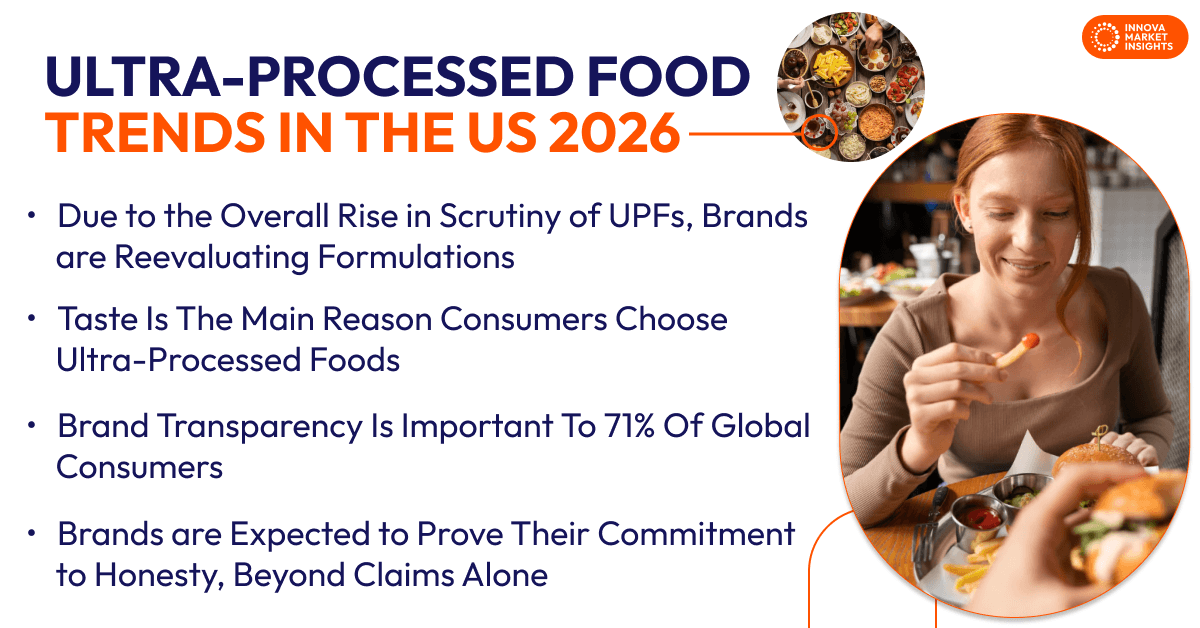
Due to the rise of the MAHA movement and the overall examination of ultra-processed foods, brands are reevaluating formulations. In the US market, consumers associate ultra-processed foods with synthetic or artificial ingredients, foods that contain lots of additives, fast food, and foods that undergo many industrial processing steps.
Ultra-processed food trends in the US also present a paradox. 42% of consumers are also against ultra-processed food consumption because they say UPFs are bad for their health. Obesity and diabetes are among the top health risks that consumers associate with ultra-processed options. Despite this fact, UPF consumption remains high, with 44% of consumers saying their main reason for engaging with them is because they taste good.
What Do Consumers Expect from Clean Products and Launches?
Innova’s ultra-processed food trends research indicates that to consumers, naturalness is linked to health perceptions. Clean labels are a core element of this, and 37% of consumers say that natural ingredients indicate a clean label for them, followed by no additives or preservatives. It is also increasingly commonplace to incorporate such claims, as more than 1 in 3 launches in the food and beverage market already carry clean label claims. Natural sweeteners and fermentation-driven ingredient alternatives are just a few of the solutions brands are tapping into to exemplify this trend and address consumer concerns related to UPFs.
How Can Manufacturers Demonstrate Genuine Transparency Efforts for US Consumers?
Consumers are scrutinizing labels to a greater extent, demanding more transparency for the products they purchase. As a result, more than just professing claims, brands are expected to prove their commitment to honesty. In fact, 71% of global consumers say that brand transparency is somewhat or very important to them, but many consumers skim on-pack messaging. This means, brands need to keep it clear and simple with short but informative ingredient lists. Technology can elevate this transparency, and QR codes are one solution to provide more information for consumers or enable greater traceability.
How Are Clean Label Innovations Expanding Beyond the Pack?
24% of US consumers associate environmental friendliness with clean label, going beyond the ingredient list. In a sustainable product, clear ingredient souring, labor practices, and sustainability certifications are the kinds of transparency that matter most to US consumers. Consumers are even willing to pay more for these values, especially ethical labor practices.
What’s Next for Ultra-Processed Food Trends?
For brands looking to combat the negative associations that come with ultra-processed foods, clean label commitments, honesty, and sustainability credentials will be crucial. Clean labels trends in 2026 indicate that these consumer preferences are now mainstream expectations, so differentiation will lie in promoting a distinct identity within the realm of naturalness. Formulations with fewer ingredients will become increasingly powerful, and emerging biotech trends will enable clean formulations that don’t sacrifice taste. Honesty in claims and ingredients are also a baseline, and for brands, expanding beyond ingredient lists into sourcing, environmental impact, and labor practices are now a part of the equation.
This article is based on Innova’s Ultra-Processed Foods: Trends, Tensions & Transformations in the US report. This report is available to purchase or with an Innova Reports subscription. Reach out to learn more